When families begin the process of hiring a nanny, few steps feel as reassuring—or as misunderstood—as background checks. Many parents assume that running a quick online criminal search is enough to confirm safety. Others believe that strong references or a warm personality make formal screening unnecessary.
The reality is far more complex.
Background checks for nannies are not a single report or a single database. When done properly, professional background screening is a layered process designed to verify identity, evaluate risk, confirm credibility, and uncover patterns that casual checks often miss.
Across Houston, Austin, and Dallas, families frequently come to Elite Nanny League after experiencing a failed hire, only to discover that the background screening they relied on was incomplete or misleading. This guide explains how background checks for nannies really work, what they reveal, what they don’t, and why professional vetting is essential for protecting children and households.
Why Background Checks Matter in Private Childcare
Hiring a nanny is fundamentally different from hiring in a traditional workplace. Nannies work inside the home, often without direct supervision, and are entrusted with children, household access, schedules, and private information.
Families are not just hiring an employee—they are granting access to their personal world.
According to the American Academy of Pediatrics, consistent caregiver safety and stability play a critical role in a child’s physical and emotional well-being. Thorough screening is therefore not optional—it is a responsibility.
Common Misconceptions About Nanny Background Checks
Before understanding how background checks actually work, it’s important to address the misconceptions that cause families to underestimate this step.
“If the Criminal Check Is Clear, They’re Safe”
A clean criminal record does not automatically mean a candidate is suitable for childcare. Many behaviors that make someone a poor nanny never result in criminal charges.
“References Are Enough”
References matter, but they are subjective and often incomplete. Background checks provide objective verification that references cannot.
“All Background Checks Are the Same”
In reality, background checks vary dramatically depending on:
Jurisdiction coverage
Identity verification methods
Data freshness
Human review
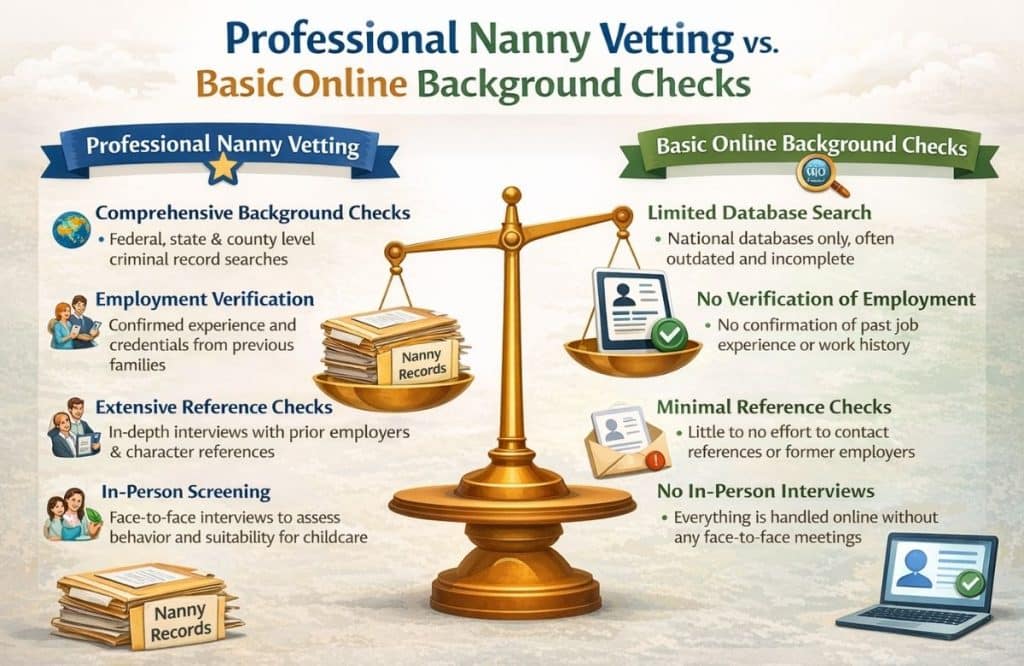
What families run independently is often far more limited than professional screening.
What Families Typically Run on Their Own
Families hiring independently often rely on:
Online background check websites
Name-based criminal searches
Limited state or national databases
While these tools may catch obvious red flags, they leave significant gaps.
The Limitations of Basic Background Checks
Database Gaps
Many online databases:
Are not updated in real time
Exclude county-level records
Miss cases filed under alternate names
According to the U.S. Department of Justice, many criminal records exist only at the county level and never appear in national databases.
Name-Based Errors
Name-only searches can:
Miss records due to spelling variations
Pull records belonging to someone else
Fail to confirm identity accurately
This creates false negatives and false positives—both dangerous outcomes in childcare hiring.
How Professional Background Checks for Nannies Really Work
Professional nanny background checks are verification-driven, not database-driven. They follow a structured, multi-layered process.
Layer 1: Identity Verification
Before any criminal search begins, professional screening confirms identity.
This includes:
Legal name and aliases
Date of birth
Social Security trace
Address history
The Federal Trade Commission emphasizes that identity verification is essential for preventing record mismatches and fraud.
Without this step, searches may be incomplete or inaccurate.
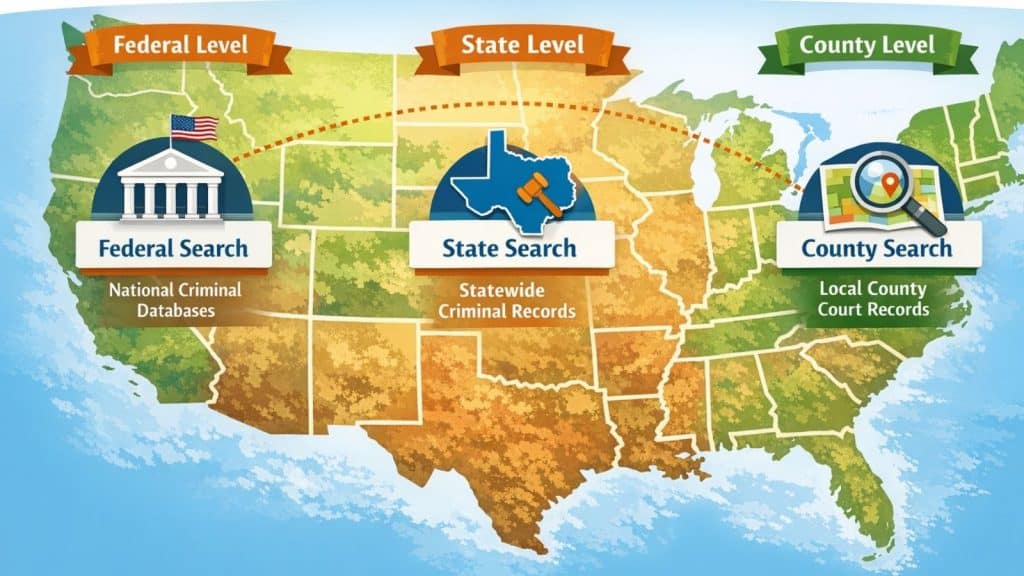
Layer 2: Multi-Jurisdiction Criminal Searches
Professional background checks include:
Federal criminal databases
State-level records
County-level searches tied to address history
County searches are especially critical, as many offenses never appear in broader databases.
Layer 3: Sex Offender Registry Searches
All professional nanny screenings include:
National sex offender registry searches
State registry checks
This step is non-negotiable in childcare hiring.
Layer 4: Driving Record Checks (When Applicable)
If a nanny will transport children, professional screening includes:
Driving history
License verification
DUI or reckless driving offenses
Driving behavior often reflects judgment and risk tolerance.
Layer 5: Employment & Reference Verification
Professional agencies do not simply collect references—they verify them.
This includes:
Confirming dates of employment
Verifying role responsibilities
Asking structured, behavior-based questions
This step frequently reveals discrepancies families would otherwise miss.
What Background Checks Do NOT Reveal
Even comprehensive background checks have limits.
They do not show:
Emotional intelligence
Boundary awareness
Professional judgment
Communication style
This is why screening must be paired with professional interviews and pattern analysis.
Why Families Miss Red Flags Without Professional Screening
Elite Nanny League integrates background screening into a broader vetting process.
Key Principles
Identity verified first
Multi-jurisdiction searches
Reference confirmation
Human review at every stage
This approach ensures families understand exactly what has been checked—and what has been verified.
Why Professional Vetting Protects Families and Nannies
Thorough screening:
Protects children and households
Protects professional nannies from false assumptions
Establishes clear expectations
Transparency benefits everyone involved.
Legal and Ethical Considerations
Professional agencies follow:
Consent-based screening
Fair hiring practices
Privacy regulations
This ensures compliance and respect for candidates.
When Background Checks Are Especially Critical
Families should insist on professional screening when:
Hiring for long-term placements
Employing live-in nannies
Hiring for high-profile households
Granting driving responsibilities
Risk increases with access and autonomy.
Serving Families Across Texas
Elite Nanny League supports families throughout:
Houston (River Oaks, Memorial, West University)
Austin (Westlake, Bee Cave, Lake Travis)
Dallas (Highland Park, University Park, Preston Hollow)
Each placement is approached with discretion and care.
Background Checks Are a Process, Not a Checkbox
Understanding how background checks for nannies really work empowers families to make safer, more informed decisions. True screening is not about speed or convenience—it is about diligence, verification, and responsibility.
Families who rely on professional vetting reduce risk, protect their household, and create the foundation for long-term placement success.
Ready for a Safer Hiring Process?
Elite Nanny League integrates comprehensive background screening into every placement—so families never have to guess what was checked or what was missed.