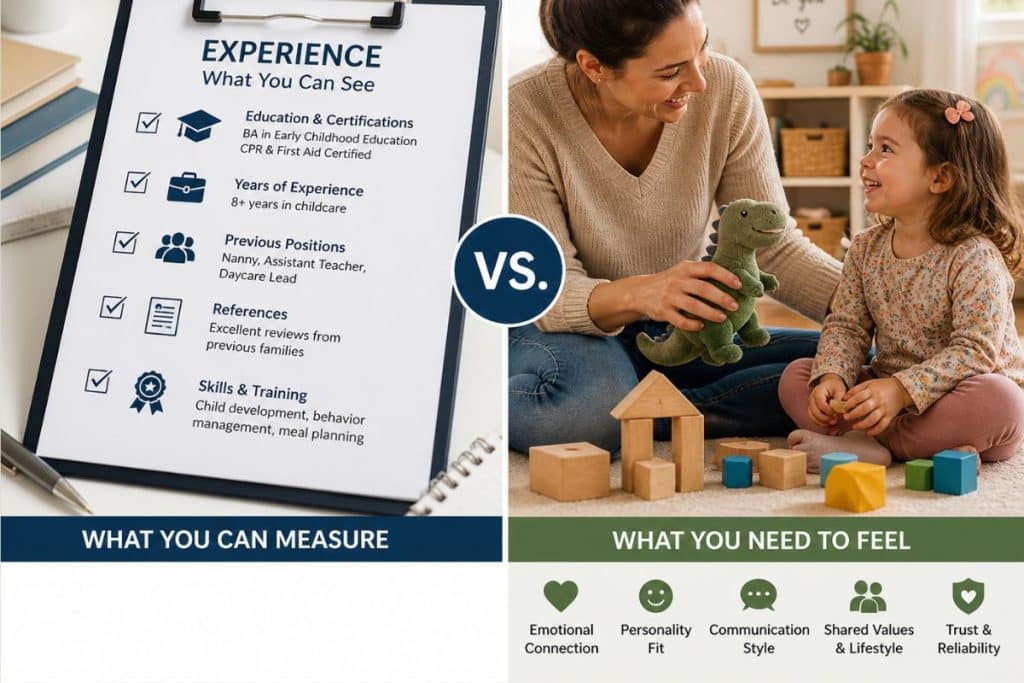
When families begin the process of hiring a nanny, one of the most common questions is: “How much experience do they have?” It’s a natural place to start. After all, experience suggests familiarity, skill, and reliability.
But here’s what many families discover—sometimes too late: experience alone does not guarantee success.
In fact, some of the most challenging nanny placements occur when a highly experienced candidate simply isn’t the right fit for the household. On the other hand, placements built on strong compatibility—even with slightly less experienced candidates—often lead to longer retention, better relationships, and more stable environments for children.
For families seeking high-quality, long-term childcare, the priority should not just be finding a qualified nanny, but finding the right nanny match.
Understanding the Difference Between Experience and Fit
Experience is measurable. It’s easy to quantify:
Years in childcare
Number of families worked with
Certifications and training
References and recommendations
Fit, however, is more nuanced. It involves:
Personality alignment
Parenting philosophy
Communication style
Lifestyle compatibility
Emotional intelligence
A nanny may check every box on paper but still struggle to integrate into your home if these deeper elements are not aligned.
According to the American Academy of Pediatrics, consistent and emotionally responsive caregiving plays a critical role in a child’s development. That level of consistency is only possible when the caregiver is truly compatible with the family environment.
Why Compatibility Drives Long-Term Success
The right nanny match creates a sense of ease within the household. There is less friction, fewer misunderstandings, and a stronger sense of partnership.
When compatibility is prioritized:
Children feel more secure and emotionally supported
Parents experience less stress and micromanagement
Daily routines run more smoothly
The nanny feels confident and valued
In contrast, even small misalignments—differences in discipline, communication, or expectations—can compound over time, leading to dissatisfaction on both sides.
This is why many families who attempt independent hiring often revisit the process within months. A mismatch doesn’t always fail immediately—it often erodes gradually.
Parenting Philosophy: The Hidden Factor in Every Placement
One of the most overlooked aspects of hiring a nanny is alignment in parenting philosophy.
Every family has a unique approach to raising children, whether clearly defined or not. A nanny becomes an extension of that approach, which makes alignment essential.
Consider the following areas:
Discipline style: Gentle parenting vs structured discipline
Education approach: Play-based learning vs structured academics
Screen time rules: Limited vs flexible usage
Daily routines: Strict schedules vs adaptable flow
If a nanny’s instincts differ from yours, even slightly, it can create subtle tension that builds over time.
For example, a nanny who values strict structure may struggle in a more flexible household, while a nanny who thrives in a relaxed environment may find rigid expectations overwhelming.
When philosophies align, however, the relationship becomes seamless. The nanny reinforces your values rather than unintentionally contradicting them.
Lifestyle Fit: A Critical but Overlooked Element
In today’s world—especially among high-performing or high-profile families—childcare needs go far beyond traditional expectations.
Modern households often require:
Flexibility with schedules
Travel readiness
Comfort with dynamic environments
Ability to manage multiple responsibilities
Professional discretion
A nanny who is highly experienced in a structured, 9-to-5 environment may not thrive in a household that requires adaptability and frequent changes.
This is where lifestyle fit becomes essential.
At agencies like Elite Nanny League, placements are approached with a deep understanding of each family’s lifestyle—not just their childcare needs. This ensures that candidates are not only qualified but capable of integrating into the family’s day-to-day reality.
Communication Style: The Foundation of a Strong Relationship
Even when experience and philosophy align, communication can make or break a placement.
Every family has a preferred communication style. Some value:
Frequent updates
Detailed daily reports
Collaborative discussions
Others prefer:
Independence
Minimal oversight
Trust-based autonomy
Neither approach is better—it’s about alignment.
A nanny who provides constant updates may overwhelm a family that prefers independence. Conversely, a nanny who works autonomously may frustrate parents who want regular communication.
Clear expectations around communication from the beginning help prevent misunderstandings and build trust.
Emotional Intelligence: The Quality That Can’t Be Taught Easily
While certifications and training can be acquired, emotional intelligence is far more difficult to develop—and incredibly important in childcare.
This level of responsiveness is not solely based on experience—it’s rooted in emotional awareness and interpersonal skills.
The Risks of Prioritizing Experience Alone
When families focus too heavily on experience, they may overlook critical compatibility factors.
This can lead to:
High turnover
Disrupted routines for children
Increased stress for parents
Additional hiring costs
rushing the process or focusing on the wrong criteria often results in repeated hiring cycles.
The cost of a mismatch is not just financial—it’s emotional and logistical as well.
Why Professional Agencies Prioritize Matchmaking
Unlike job boards or independent hiring platforms, professional nanny agencies focus on matchmaking, not just placement.
This involves:
In-depth family consultations
Personality and lifestyle assessments
Thorough candidate vetting
Long-term compatibility evaluation
Agencies understand that a successful placement is not defined by how quickly a position is filled, but by how long it lasts.
This approach aligns with insights from the International Nanny Association, which emphasizes the importance of structured hiring and professional standards in childcare.
Real-Life Example: Experience vs Fit
Consider two candidates:
Candidate A:
12 years of experience
Extensive references
Highly structured approach
Candidate B:
5 years of experience
Strong interpersonal skills
Flexible and adaptable
For a structured household, Candidate A may be the perfect fit. For a dynamic, fast-paced family, Candidate B may be the better choice.
The “better” nanny is not universal—it depends entirely on the family.
The Long-Term Benefits of the Right Nanny Match
When the right match is made, the impact is significant and long-lasting.
Children
Strong emotional bonds
Consistent routines
Increased sense of security
Parents
Reduced stress
Greater productivity
Peace of mind
Household
Stability and efficiency
Improved communication
Long-term continuity
These outcomes are rarely achieved through experience alone—they are the result of intentional, strategic matching.
How to Identify the Right Match for Your Family
Before beginning your search, consider the following:
What is your parenting philosophy?
What level of structure does your household require?
What communication style do you prefer?
What lifestyle demands should a nanny be comfortable with?
Clarity in these areas will help guide your search and improve your chances of finding the right fit.
Final Thoughts
Experience will always play an important role in hiring a nanny. It provides a foundation of knowledge, skill, and confidence.
But when it comes to long-term success, experience is only part of the equation.
The true key lies in finding the right nanny match—one that aligns with your values, lifestyle, communication style, and family dynamic.
Because at the end of the day, the right nanny isn’t just someone who can do the job.
They’re someone who becomes a trusted, consistent, and invaluable part of your family’s life.