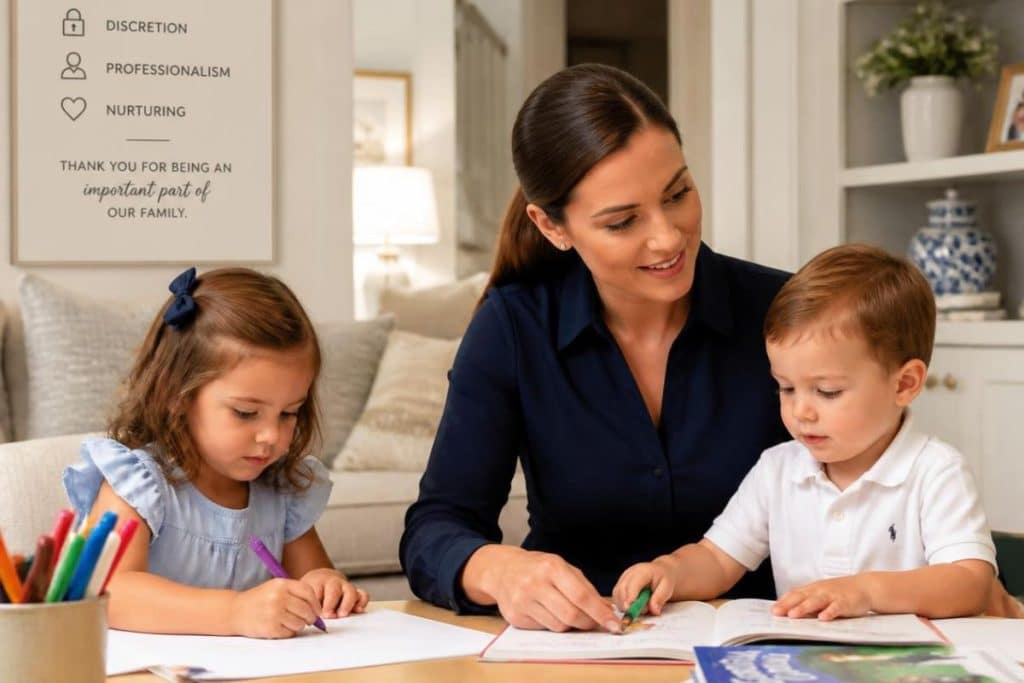
When families think about what makes an exceptional nanny, they often focus first on childcare experience.
How many years has the nanny worked professionally?
What ages have they cared for?
Are they CPR and First Aid trained?
Can they manage multiple children?
Do they understand child development?
These qualifications matter. But there is another skill that influences nearly every part of the nanny-family relationship:
Communication.
A nanny can have years of experience and impressive credentials, but if they struggle to communicate clearly with parents, children, or other household professionals, even relatively small issues can become sources of frustration.
Exceptional nannies understand that communication is part of professional childcare.
They know how to keep parents informed without overwhelming them, listen carefully to instructions, communicate with children at developmentally appropriate levels, raise concerns professionally, navigate disagreements, and maintain appropriate boundaries.
Strong nanny communication skills don't simply make daily routines easier. They help create trust.
And when a family entrusts someone with their children, trust is fundamental.
Why Communication Matters So Much in a Nanny-Family Relationship
A nanny works in an unusually personal professional environment.
Unlike many employees, they work inside the family's home and may become closely involved in children's everyday lives.
Parents and nannies regularly exchange information about sleep, meals, behavior, health, school, activities, developmental milestones, schedules, emotions, and household routines.
Small details matter.
Perhaps a toddler skipped a nap.
A child barely touched lunch.
A teacher mentioned a concern during pickup.
A preschooler seemed unusually quiet.
A baby tried a new food.
An older child shared something important on the drive home.
Parents rely on their nanny to determine which information should be communicated and how.
The strongest professional nannies don't simply communicate more. They communicate effectively.
1. Exceptional Nannies Know How to Listen
Good communication starts with listening.
Families need nannies who can hear not only instructions but also the priorities behind them.
A parent might explain that their toddler is struggling with bedtime after inconsistent afternoon naps. A strong nanny doesn't simply hear, "Nap at 1:00."
They understand that consistency during the day supports a larger family goal.
Active listening involves paying attention, asking appropriate follow-up questions, and clarifying expectations when necessary.
This skill becomes especially important during the first weeks of a new placement, when the nanny is learning the family's routines, preferences, and communication style.
Listening also demonstrates professional respect.
Rather than assuming that a strategy used successfully with a previous family will automatically work in a new household, exceptional nannies first seek to understand how this family approaches childcare.
2. They Communicate Clearly and Concisely
More communication isn't always better communication.
Parents with demanding professional schedules may not want dozens of nonessential messages throughout the workday.
At the same time, they shouldn't reach the end of the day without knowing about something significant.
Exceptional nannies develop a sense of what information requires immediate communication, what can wait, and what simply needs to be included in an end-of-day update.
For example, a serious injury requires immediate contact.
A slightly shorter-than-normal nap probably doesn't.
Good professional communication provides parents with enough information to remain connected and informed without requiring them to manage childcare remotely throughout the day.
3. They Understand Each Family's Communication Preferences
There is no universal communication system that works for every nanny-family relationship.
Some parents want photographs and updates throughout the day.
Others prefer a brief message only when necessary.
Some families use a shared calendar.
Others maintain a written nanny log.
Some prefer a detailed conversation during the evening handoff.
An exceptional nanny adapts to reasonable family preferences while also communicating their own needs.
This is why communication expectations should be discussed during the hiring process.
"How did you communicate with your previous employers, and what system worked best for you?"
The answer helps families determine whether expectations are naturally compatible.
4. They Communicate With Children at Their Developmental Level
Professional communication isn't limited to conversations between adults.
Exceptional nannies know how to communicate differently with an 18-month-old, a five-year-old, and a twelve-year-old.
Young children may need simple language, repetition, visual cues, and clear choices.
Older children may benefit from explanations, collaborative problem-solving, and opportunities to express their perspectives.
A nanny who understands child development adjusts both language and expectations accordingly.
For example, telling a toddler, "We have to leave the park now because we have several obligations this afternoon," is unlikely to be particularly effective.
A developmentally appropriate approach might be:
"Two more turns on the slide, then we're putting on our shoes and going home."
Clear communication helps children understand expectations and can reduce unnecessary conflict.
Professional judgment is closely connected to communication.
Not every event requires an immediate call or text.
But some situations do.
Exceptional nannies understand the difference.
A parent may need immediate communication if there is a significant injury, urgent medical concern, serious safety issue, unexpected emergency, or another situation requiring parental input.
Families and nannies should discuss these expectations before an emergency occurs.
Nannies should also have clearly documented emergency contact information and understand the family's procedures.
CPR and First Aid preparation can further support a caregiver's ability to respond appropriately during emergencies. Families can find training information through the American Red Cross.
7. They Don't Hide Mistakes
Nobody working with children performs every task perfectly.
Exceptional professionalism isn't demonstrated by never making a mistake.
It is demonstrated by how someone responds when a mistake occurs.
Suppose a nanny accidentally forgets an item needed for an activity.
Perhaps a child's favorite cup gets broken.
Maybe they misunderstand an instruction.
A professional nanny communicates appropriately, accepts responsibility when necessary, and focuses on resolving the situation.
Attempting to hide minor mistakes can damage trust far more than the original issue.
Families should feel confident that their nanny will communicate honestly even when the conversation is uncomfortable.
8. They Can Receive Constructive Feedback
The ability to receive feedback is one of the most valuable nanny communication skills.
Every household operates differently.
Even highly experienced nannies need time to learn a new family's preferences.
Parents may occasionally request changes.
They might want the nanny to adjust a routine, communicate differently, modify an activity schedule, or approach a responsibility another way.
An exceptional nanny doesn't automatically interpret reasonable feedback as personal criticism.
Instead, they listen, ask questions when necessary, and determine how to incorporate the feedback into their work.
This doesn't mean nannies should never disagree.
Professional communication works both ways.
But being able to discuss adjustments without unnecessary defensiveness supports a much healthier employment relationship.
9. They Know How to Give Parents Feedback Too
Parents also need feedback.
A nanny may spend more waking hours with a child during the workweek than either parent does. That gives them valuable opportunities to notice patterns.
Perhaps the nanny observes that a toddler is consistently exhausted before nap time.
Maybe homework has become unusually frustrating.
Perhaps a child is suddenly anxious before a particular activity.
A professional nanny should feel comfortable sharing relevant observations.
The key is how the information is communicated.
Instead of making judgments, strong nannies describe what they have observed.
For example:
"I've noticed that she's been getting upset before soccer practice this week. She hasn't explained why yet, but I wanted to make sure you knew."
That communicates useful information without jumping to unsupported conclusions.
10. They Address Problems Before Resentment Builds
Small workplace frustrations can become large problems when nobody discusses them.
Perhaps parents regularly arrive home later than the agreed end time.
Maybe additional household responsibilities are gradually being added to the nanny's role.
Perhaps communication outside working hours has become excessive.
A professional nanny should be able to address concerns respectfully before frustration becomes resentment.
The same applies to families.
Parents shouldn't allow minor issues to accumulate for months and then surprise the nanny with a long list of complaints.
Regular communication helps both sides make smaller adjustments before they become significant problems.
11. They Understand the Importance of Tone
The words someone uses matter.
So does tone.
This is particularly important when communicating with children.
A nanny can establish boundaries firmly without being harsh.
They can redirect behavior without humiliating a child.
They can correct mistakes without creating fear.
Tone also matters with adults.
Written communication can be especially easy to misinterpret because texts lack facial expressions and vocal cues.
Exceptional nannies understand when a quick message is appropriate and when a more nuanced issue deserves an in-person or telephone conversation.
12. They Communicate Professionally During Conflict
Disagreements happen in healthy professional relationships.
The goal isn't to eliminate every disagreement.
It's to handle differences constructively.
Suppose a nanny believes a child's afternoon schedule has become too demanding.
Instead of saying:
"You schedule way too many activities."
A more professional approach might be:
"I've noticed that he's becoming very tired by Wednesday and has been struggling during the final activity. Would you be open to talking about whether the schedule needs an adjustment?"
The second approach focuses on observations and collaboration rather than criticism.
Families should look for candidates who can disagree respectfully.
Behavioral interview questions can help uncover this ability.
Ask:
"Tell us about a time you disagreed with an employer. How did you handle it?"
13. They Respect Confidentiality
Communication skills also involve knowing what not to communicate.
Nannies may have access to highly personal information about the families they serve.
They may know travel schedules, children's schools, household routines, professional information, personal relationships, or details about the family's residence.
Exceptional nannies understand that this information isn't theirs to share.
Confidentiality extends to conversations with friends, relatives, other household employees, and social media.
For executive, high-profile, or public-facing households, these expectations may be particularly important. Our guide to confidential childcare solutions for executives and public figures explains why privacy and discretion should be discussed clearly during placement.
14. They Use Social Media Responsibly
Digital communication has created additional boundaries families and nannies need to discuss.
Can the nanny photograph the children?
Can those photographs be sent to family members?
Can anything involving the children appear on social media?
Should locations ever be tagged?
What about photographs taken inside the family's home?
Families shouldn't assume candidates automatically share their privacy expectations.
These rules should be discussed explicitly.
A professional nanny should respect the family's digital privacy policies even if their personal approach to social media is different.
15. They Maintain Professional Boundaries
Warm nanny-family relationships can become incredibly meaningful.
But closeness should not eliminate professional boundaries.
Communication expectations may include when the nanny is available outside working hours, how schedule changes are requested, how personal matters are discussed, and which channels are used for work-related communication.
Clear boundaries benefit both sides.
They allow nannies to maintain appropriate personal time while giving families predictable methods for communicating about employment matters.
16. They Communicate Effectively During Transitions
Transitions are a major part of children's lives.
Starting school.
Welcoming a sibling.
Moving homes.
Changing routines.
Ending naps.
Beginning toilet learning.
Parents returning to work.
A nanny's communication can make these transitions easier.
Exceptional nannies communicate with parents so that expectations remain consistent across caregivers.
They also explain changes to children in developmentally appropriate ways.
Consistency between parents and nanny can provide children with greater predictability during periods of change.
17. They Can Work as Part of a Household Team
Some nannies work independently with relatively little interaction with other household professionals.
Others work within larger private households.
They may need to communicate with household managers, chefs, assistants, drivers, tutors, security professionals, or additional childcare providers.
In these environments, professional communication becomes even more important.
Strong nannies understand reporting structures and responsibilities.
They communicate necessary information without creating unnecessary confusion.
They respect the roles of other household professionals while remaining focused on the children's needs.
For families with complex household structures, previous experience working collaboratively can be an important qualification to explore during interviews.
18. They Document Important Information When Necessary
Verbal communication isn't always enough.
Depending on the children's ages and household preferences, families may benefit from written records involving meals, naps, medication, activities, appointments, or other relevant information.
A shared digital calendar may help coordinate schedules.
An infant log may track feeding and sleep.
A family assistant role may require more extensive organizational systems.
Exceptional nannies understand that good documentation supports communication rather than replacing it.
The goal isn't paperwork for its own sake.
It's making sure important information doesn't disappear between busy schedules.
19. They Know How to Communicate During Travel
Travel nanny positions can introduce additional communication challenges.
Schedules may change rapidly.
Parents and nanny may be moving between airports, hotels, restaurants, activities, and unfamiliar environments.
Expectations around working hours and off-duty time may also differ from the family's normal routine.
Clear communication before and during travel helps prevent misunderstandings.
Families should discuss schedules, accommodations, responsibilities, downtime, expenses, and emergency plans in advance.
A professional nanny who communicates proactively can make family travel significantly smoother.
20. They Communicate Consistently, Not Only When Something Is Wrong
Communication shouldn't become something that happens only when there is a problem.
Positive information matters too.
Parents want to know when their child learns something new, handles a difficult situation well, makes a new friend, reaches a milestone, or simply has a wonderful day.
Sharing these moments strengthens the relationship between parents and nanny.
It also demonstrates that the nanny is genuinely observing and engaging with the child rather than simply completing tasks.
How Families Can Evaluate Nanny Communication Skills
Communication skills can be difficult to evaluate from a resume.
Families need to observe them throughout the hiring process.
Pay attention to how candidates respond to scheduling requests.
Are their messages clear?
Do they communicate professionally?
Do they answer questions directly?
Do they listen during interviews?
Do they ask thoughtful questions?
Can they discuss previous employers respectfully, even when a placement was difficult?
Then use behavioral questions.
Ask candidates to describe situations where communication actually mattered.
For example:
"Tell us about a time you needed to deliver difficult information to a parent."
"Describe a misunderstanding you had with an employer and how you resolved it."
"How would you tell us if you disagreed with one of our childcare decisions?"
The answers provide insight into both communication skills and professional judgment.
References Can Reveal How Someone Really Communicates
Candidates naturally want to make a positive impression during interviews.
Professional references provide another perspective.
Ask former employers:
How did the nanny communicate throughout the day?
Did they provide enough information?
Were they comfortable raising concerns?
How did they respond to feedback?
How did they handle disagreements?
Were there ever communication problems?
Would you describe them as proactive?
Specific questions usually produce more useful answers than simply asking whether the candidate was "a good communicator."
The nanny's working style needs to complement the family's expectations.
Families Have Communication Responsibilities Too
Strong nanny communication isn't solely the nanny's responsibility.
Parents contribute significantly to the quality of the relationship.
Families should provide clear expectations.
Give reasonable notice when schedules change.
Communicate concerns promptly.
Respect working hours and professional boundaries.
Provide feedback constructively.
Avoid contradicting the nanny unnecessarily in front of children.
Make sure both parents communicate consistent expectations when possible.
When responsibilities change, discuss them rather than allowing "job creep" to occur silently.
Professional communication works best when it is reciprocal.
Regular Check-Ins Can Prevent Larger Problems
Families don't need to wait for an annual review to discuss how the placement is going.
Regular check-ins can be extremely useful, particularly during the first few months.
These conversations might address what is working well, whether routines need adjustment, changes in children's needs, upcoming schedule changes, and any questions either side wants to discuss.
Check-ins don't need to be formal or lengthy.
The important thing is creating a predictable opportunity for honest conversation.
When communication becomes part of the relationship's normal rhythm, difficult topics are often easier to discuss.
Communication Should Be Addressed in the Employment Agreement
Some communication expectations can be established from the beginning.
A nanny agreement might clarify work schedules, procedures for schedule changes, emergency contacts, confidentiality expectations, social media rules, and responsibilities.
Families should also clearly define compensation and working conditions rather than relying on informal assumptions.
Clear professional expectations give both families and nannies a stronger foundation for communication.
Why Professional Nanny Agencies Evaluate Communication
A nanny's communication style can be observed before they ever meet a family.
How do they communicate during the application process?
Do they provide requested information?
Are they responsive?
Can they discuss previous positions professionally?
Do their references describe strong communication?
How do they respond to detailed interview questions?
At Elite Nanny League, evaluating a candidate means looking beyond the number of years listed on a resume.
Professional experience matters, but so do judgment, communication, expectations, professionalism, references, and potential compatibility with the family.
Exceptional Communication Builds Exceptional Nanny Relationships
The best nanny-family relationships are built on more than childcare experience.
They are built on trust.
And trust depends heavily on communication.
Exceptional nanny communication skills include listening carefully, sharing relevant information, speaking to children appropriately, handling feedback professionally, raising concerns early, respecting confidentiality, navigating disagreements, and maintaining healthy boundaries.
These abilities may not be as easy to list on a resume as CPR certification or years of infant experience.
But families experience their impact every day.
A nanny who communicates well helps parents feel informed without feeling overwhelmed.
They help children understand expectations and express emotions.
They help prevent small misunderstandings from becoming major conflicts.
And they help create the professional partnership that allows excellent childcare to thrive.
At Elite Nanny League, we believe exceptional placements depend on both qualifications and compatibility. Communication is one of the clearest places where those two priorities come together.
Because the right nanny doesn't simply know how to care for children.
They know how to listen, communicate, collaborate, and build the trust that allows an entire family to feel supported.