How to Pay Your Nanny Legally (And Avoid Costly Mistakes)Read More →
Learn how to pay your nanny legally, including payroll setup, taxes, and common mistakes families should avoid.


Hiring a nanny is not just a childcare decision — it is also a legal and financial responsibility.
Many families are surprised to learn that when they hire a nanny, they are no longer just parents — they become household employers.
This means you are responsible for:
Yet despite these requirements, many families unknowingly make costly mistakes when it comes to paying their nanny.
Some assume they can pay “off the books.” Others rely on incorrect advice from online forums or friends.
The reality is that improper payment practices can lead to:
Understanding how to pay your nanny legally protects both your family and your employee — and sets the foundation for a professional, long-term working relationship.
If you’re just beginning your hiring journey, you may also want to review The Complete Guide to Hiring a Long-Term Nanny, which outlines the full process from hiring to employment.
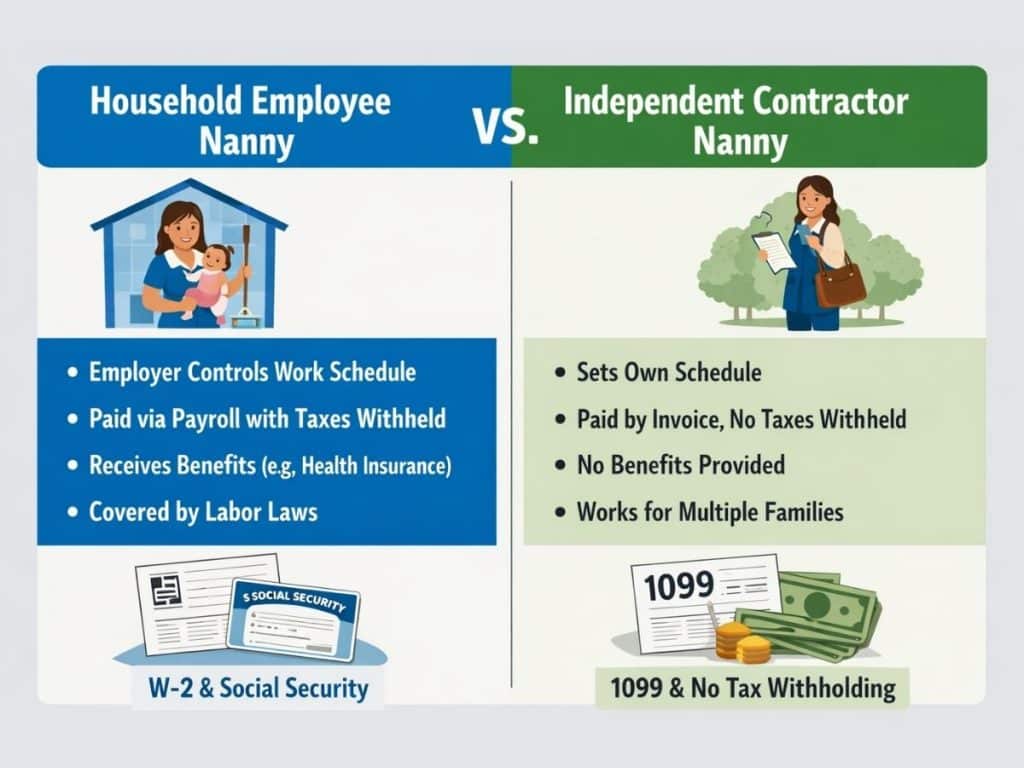
Paying your nanny legally means treating them as a household employee, not an independent contractor.
This includes:
The IRS Household Employer’s Tax Guide (Publication 926) provides a comprehensive overview of these responsibilities:
Families who follow these guidelines ensure compliance with federal regulations and avoid unnecessary risk.
One of the most common mistakes families make is misclassifying their nanny as an independent contractor.
A nanny is almost always considered a household employee because:
Independent contractors, on the other hand, control how and when they perform their work.
Misclassification can lead to serious penalties from the IRS.
In short:
If you hire a nanny, you are their employer.
The term “nanny tax” refers to the taxes families must pay when employing a household worker.
These typically include:
These taxes are required once you pay a nanny above a certain annual threshold.
The IRS outlines these thresholds and requirements in detail here:
Failing to pay these taxes can result in penalties, back payments, and interest charges.
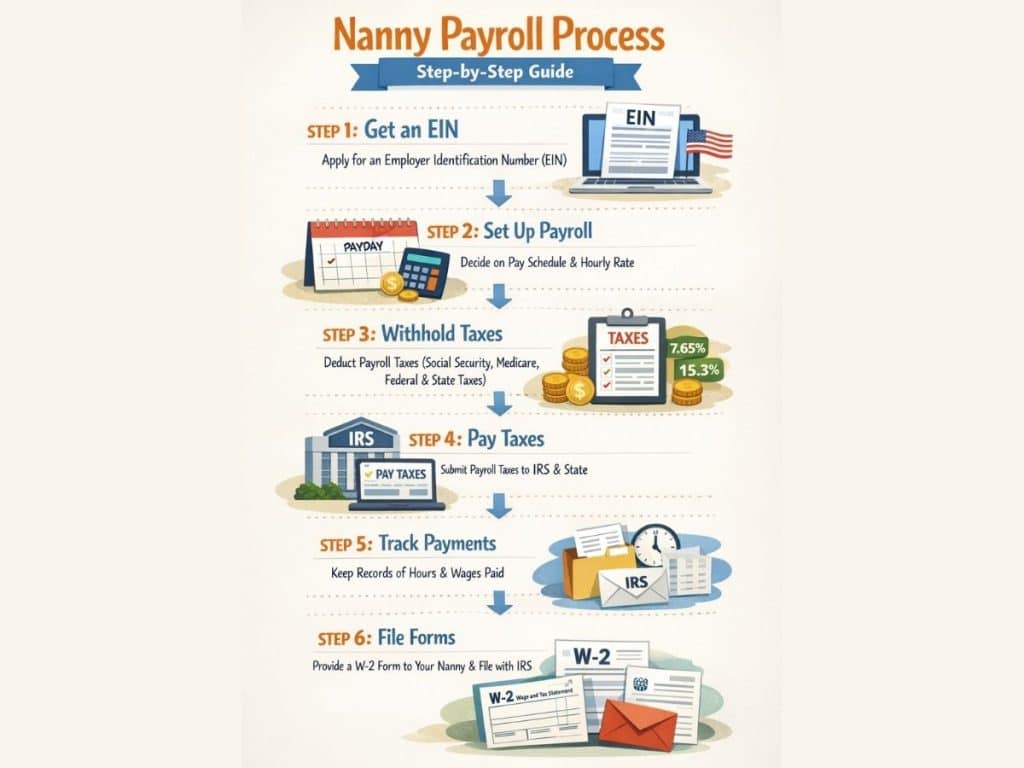
Before paying your nanny legally, you must obtain an Employer Identification Number (EIN) from the IRS.
This number is used for:
You can apply for an EIN directly through the IRS website.
This step is required before setting up payroll.
Once you have an EIN, the next step is establishing a payroll system.
Payroll ensures:
Families can choose to:
Many families prefer payroll services because they handle:
As a household employer, you are responsible for:
These contributions are required under federal law.
The U.S. Department of Labor provides guidance on domestic worker protections and wage requirements here:
At the end of the year, families must provide their nanny with a W-2 form.
This form reports:
The nanny uses this form to file their personal taxes.
Providing a W-2 is a key requirement of legal employment.
Nannies are typically classified as non-exempt employees, meaning they are entitled to:
Under the Fair Labor Standards Act (FLSA):
For example:
If your nanny earns $25/hour, overtime would be $37.50/hour.
Understanding these rules helps families remain compliant and avoid disputes.

Even well-intentioned families often make mistakes when paying their nanny.
Some families attempt to pay cash without reporting income.
While this may seem simpler, it creates serious risks:
Legal payroll protects both parties.
As mentioned earlier, treating a nanny as an independent contractor can result in IRS penalties.
Always classify your nanny correctly as a household employee.
Failing to pay overtime is one of the most common compliance issues.
Even if a nanny agrees to a flat rate, overtime laws still apply.
A written agreement helps define:
Without one, misunderstandings can arise.
Learn more in Nanny Contracts Explained: What Every Family Must Include.
Some families delay setting up payroll, assuming they can fix it later.
This can lead to:
It’s best to start payroll correctly from day one.
While legal payroll requires more effort, it offers significant benefits.

Legal employment reduces the risk of:
Your nanny receives:
Families who pay legally may qualify for:
These benefits can help offset childcare costs.
Professional nannies expect legal employment.
Providing proper payroll:
As discussed in What Elite Families Look for in a Professional Nanny, top candidates prioritize families who treat the role as a professional position.
Because of the complexity of payroll, many families choose to outsource this process.
Payroll services handle:
This simplifies the process and reduces the risk of errors.
Paying your nanny legally is just one part of building a successful placement.
Families should also focus on:
These elements are covered in:
Together, these practices create stable, long-term childcare relationships.
High-quality nanny placement services prioritize legal employment from the beginning.
Agencies often:
This reduces risk and improves placement success.
If you’re considering professional support, explore Nanny Placement Services.
Paying your nanny legally is not just about compliance — it’s about creating a professional, respectful, and sustainable working relationship.
While the process may seem complex at first, it becomes manageable with the right systems in place.
By following legal guidelines, families can:
Taking the time to do things correctly from the beginning is one of the best investments you can make in your childcare arrangement.
Schedule your consultation today!

Questions? We’re here to help.
Learn how to pay your nanny legally, including payroll setup, taxes, and common mistakes families should avoid.
High-quality nanny placements focus on compatibility, not speed. Learn why taking time to find the right fit leads to long-term success.
Is a live-in nanny right for your family? Learn the benefits, costs, and lifestyle considerations of hiring a live-in caregiver.


