Hiring a night nanny is an important decision for any family preparing to welcome a newborn. Overnight care affects your baby’s safety, feeding routine, sleep environment, and the way your household functions during the early weeks and months.
A strong interview helps parents understand more than a caregiver’s résumé. It gives you the opportunity to learn how a candidate approaches newborn care, communicates with parents, manages overnight responsibilities, and responds when plans change.
The right questions can help you identify a professional who is experienced, dependable, calm, and aligned with your family’s expectations.
Why the Night Nanny Interview Matters
Overnight newborn care is highly personal. A night nanny may manage feedings, diaper changes, soothing, sleep logs, bottle preparation, and morning communication while parents rest nearby.
Because the role takes place inside your home during vulnerable hours, experience alone is not the only factor to consider. Families should also evaluate judgment, communication style, reliability, professionalism, and compatibility with their household.
The interview should feel like a two way conversation. You are learning about the candidate, and the candidate is learning about your baby, your expectations, and the type of support you need.
Questions About Newborn Care Experience

Begin with questions that help you understand the candidate’s direct experience with newborns and overnight care.
Ask questions such as:
- How many newborns have you cared for overnight?
- How long were your previous overnight assignments?
- What ages were the babies when you began working with them?
- Have you worked with families using breast milk, formula, or combination feeding?
- What responsibilities were included in your previous overnight roles?
- Have you cared for twins, premature babies, or babies with additional needs?
- What type of newborn care training or certifications have you completed?
Listen for specific examples rather than general statements. An experienced candidate should be able to explain the types of overnight responsibilities they handled, how they communicated with parents, and how they adjusted care to meet each baby’s needs.
Questions About Feeding and Overnight Routines

Feeding is often one of the most important parts of overnight newborn care. Your family may have a specific feeding plan involving breastfeeding support, expressed breast milk, formula, bottle feeding, or a combination of methods.
Ask the candidate how they have supported different feeding routines and how they document feedings throughout the night.
Helpful feeding questions include:
- How do you support a breastfeeding parent during overnight care?
- Are you comfortable with breast to bottle transitions?
- How do you prepare and organize bottles during an overnight shift?
- How do you track feeding times and amounts?
- How do you handle a baby who is difficult to settle after feeding?
- How do you communicate changes in feeding patterns to parents?
- How do you clean and organize feeding supplies?
Parents should also explain their own preferences. A professional caregiver should be comfortable following the family’s established instructions while communicating questions or concerns clearly.
Families can review current CDC guidance about bottle feeding and infant feeding supplies when preparing their household routine.
Questions About Safe Sleep and Soothing
Safe sleep should be discussed during every newborn care interview. Parents should ask how the candidate approaches the baby’s sleep environment, soothing, transfers, and nighttime wakeups.
Consider asking:
- How do you create a safe sleep environment for a newborn?
- What steps do you take before placing a baby down to sleep?
- How do you respond when a newborn wakes frequently?
- What soothing techniques have worked well for you?
- How do you handle a baby who only settles while being held?
- How do you support age appropriate sleep routines?
- How do you communicate if the baby’s sleep pattern changes?
The American Academy of Pediatrics recommends placing babies on their backs for naps and nighttime sleep on a firm, flat, noninclined sleep surface. The sleep area should be free of loose blankets, pillows, stuffed animals, and other soft objects. Parents can review the American Academy of Pediatrics safe sleep recommendations for additional information.
A night nanny should understand that soothing a baby and creating a safe sleep environment are connected responsibilities. The caregiver should also be willing to follow the parents’ instructions and any guidance provided by the child’s healthcare provider.
Questions About Communication With Parents
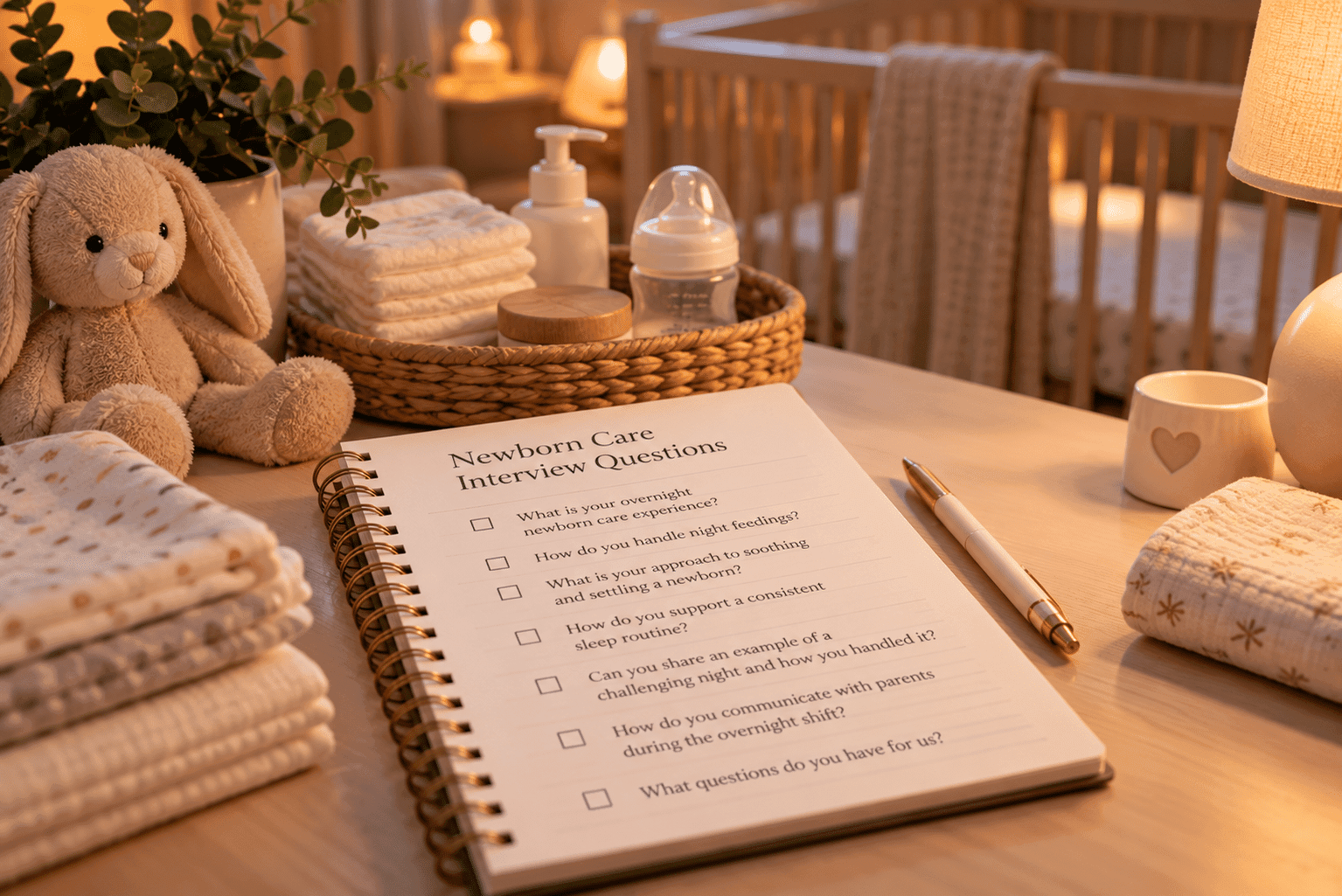
Good communication makes overnight care more comfortable for both parents and caregivers. Ask how the candidate prefers to receive information, document care, and communicate updates during and after the shift.
Questions to ask include:
- How do you typically provide a morning update?
- What information do you include in an overnight care log?
- How do you communicate a concern during the night?
- How do you handle differences between the parents’ instructions and the baby’s changing needs?
- How do you respond when parents change part of the routine?
- How do you maintain privacy and discretion inside a family’s home?
Families should explain whether they prefer a written log, a mobile application, a text message, or a verbal morning handoff. The best communication system is one that is clear, consistent, and easy for everyone to follow.
Questions About Reliability and Professionalism
Overnight care depends on consistency. Parents need to know that the caregiver will arrive on time, remain attentive throughout the shift, and communicate promptly if an emergency or scheduling issue occurs.
Ask the candidate:
- How do you manage overnight assignments with multiple shifts each week?
- What would you do if you were unexpectedly unable to work?
- How do you prepare for a long overnight shift?
- How do you stay alert and attentive throughout the night?
- How do you handle confidentiality inside a private home?
- Are you comfortable following household policies and security procedures?
- Can you provide recent professional references from overnight families?
Pay attention to whether the candidate answers directly and professionally. Reliability is not only about showing up. It also includes preparedness, honesty, communication, and respect for the family’s home.
Questions About Household Fit

Every family has its own communication style, household rhythm, and expectations. A candidate may have excellent experience but still not be the right fit for your family if your approaches or expectations are very different.
Discuss topics such as:
- How involved parents prefer to be during the overnight shift
- Whether the caregiver will work in the nursery, parents’ bedroom, or another area
- How household supplies and feeding equipment should be organized
- Whether the caregiver will assist with light newborn related organization
- How parents prefer to receive updates
- What privacy and guest expectations apply in the home
- How the family prefers to handle feedback and adjustments
Parents should feel comfortable discussing the practical details of the role. Clear expectations at the beginning help prevent confusion after the placement begins.
Questions to Ask the Candidate’s References
Professional references can provide valuable insight into a candidate’s reliability, communication, newborn care skills, and ability to work inside a private household.
Consider asking references:
- What were the candidate’s primary responsibilities?
- How long did the candidate work with your family?
- Was the candidate reliable and punctual?
- How did the candidate communicate overnight updates?
- How did the candidate respond when your baby’s routine changed?
- Did the candidate respect your privacy and household expectations?
- Would you hire this caregiver again?
Ask references for specific examples whenever possible. A detailed response is generally more helpful than a simple statement that the caregiver was good.
Questions Families Should Ask Themselves
The interview should help you evaluate the candidate, but it should also help you clarify your own needs.
Before making a decision, ask yourself:
- Did the candidate listen carefully to our concerns?
- Did the candidate explain their experience clearly?
- Did we feel comfortable discussing feeding and sleep preferences?
- Did the candidate demonstrate sound judgment?
- Did the candidate seem respectful of our home and privacy?
- Can we see this person becoming a dependable part of our newborn care plan?
Trust your observations, but also rely on a structured process. Strong placements are built through experience verification, reference checks, clear expectations, and careful attention to fit.
How a Professional Nanny Agency Can Help
Families do not have to manage every part of the search independently. A professional nanny agency can help clarify the type of overnight care needed, evaluate candidate experience, coordinate interviews, and support the family throughout the placement process.
Elite Nanny League’s night nanny services connect families with professional caregivers who understand the responsibilities involved in overnight newborn care.
Families can also visit the Elite Nanny League Families FAQ to learn more about the placement process, screening, timelines, and family support.
Final Night Nanny Interview Checklist
- Ask about direct overnight newborn experience.
- Discuss feeding methods and bottle preparation.
- Review safe sleep expectations.
- Ask how the caregiver documents overnight care.
- Discuss communication preferences.
- Review reliability, scheduling, and emergency procedures.
- Talk about privacy and household expectations.
- Contact recent professional references.
- Evaluate personality, judgment, and household fit.
- Confirm the schedule, responsibilities, compensation, and employment expectations in writing.
Choosing a night nanny is about more than finding someone available to work overnight. It is about finding a professional who can provide safe, dependable, and reassuring support during an important transition for your family.
Ready to Find the Right Overnight Care?
Elite Nanny League helps families connect with experienced professional nannies and newborn care specialists who understand the importance of safety, communication, discretion, and family fit.
Contact Elite Nanny League today to discuss your family’s overnight care needs.
Call 713-331-9434 or email info@elitenannyleague.com.
You Might Also Like


